Home / Applications / Space & Satellite
Applications

Space & Satellite

The passive device layer for space laser communication and optical inter-satellite links — engineered for vacuum, wide thermal cycling and radiation-constrained environments, and screened to Telcordia GR-1221 / GR-1073 reliability programs.

Discuss your terminal design View high-reliability components

The Challenge

Free-space optical links have moved from flagship demonstrations — NASA's LCRD / ILLUMA-T relay and ESA's EDRS — to constellations buying interoperable terminals by the thousand under standards such as SDA's OCT. Every one of those terminals is built around a fiber-based 1550 nm transceiver, and every passive device inside it must survive the mission.

Vacuum, Thermal Cycling & Radiation

On orbit there is no convection and no service call. Materials must not outgas onto precision optics in vacuum (ECSS-Q-ST-70-02 class screening), alignment must hold through launch vibration and years of −40 °C-class thermal swings, and ionizing radiation darkens unprotected fiber and glass — the radiation-induced attenuation that degrades EDFAs and passive paths alike.

Every dB Is Budgeted

Across thousands of kilometres, link margin is counted in photons. The transmit chain needs high-power 1550 nm amplification — C-band dominates precisely because it reuses the mature EDFA and telecom-component ecosystem — while the receive chain cannot give anything back: every dB saved in isolators, filters and couplers is a dB added to margin.

From One-Off to Constellation Volume

Programs like SDA's proliferated LEO architecture plan hundreds of satellites carrying multiple optical terminals each. Passive components are no longer hand-built research items — they must ship in volume, with tight unit-to-unit consistency in loss, isolation and polarization performance, lot after lot.

How We Fit In

Triple-Stone builds the passive photonic devices inside the 1550 nm transceiver chains of optical terminals — from the EDFA booster to the telescope interface — on Telcordia-qualified platforms, with custom engineering for space-constrained environments.

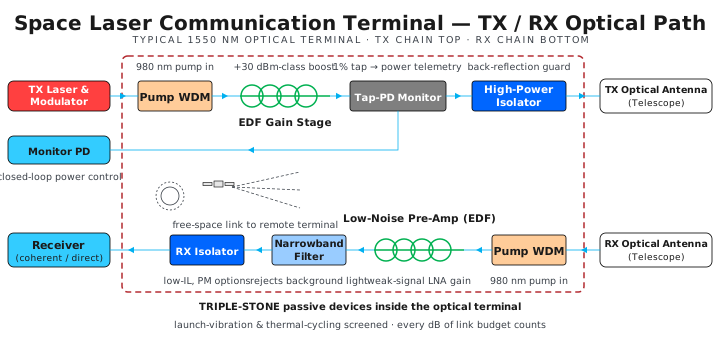
Typical space laser communication terminal TX/RX optical path: TX chain with pump WDM, EDF gain stage, tap-PD monitor and high-power isolator up to the telescope; RX chain with low-noise EDF pre-amp, narrowband filter and RX isolator — passive devices by Triple-Stone

Typical TX/RX optical path of a space laser communication terminal — the passive devices inside the dashed line are supplied by Triple-Stone.

On the transmit side, 980 nm pump light enters a pump WDM and drives the EDFA gain stage to launch power; a high-power isolator guards against back-reflection, a tap-PD monitor feeds the closed-loop power control, and the beam leaves through the TX optical antenna. On the receive side, the weak signal from the RX antenna is raised by a low-noise pre-amplifier, cleaned by a narrowband filter that rejects background light, and passed through a low-loss RX isolator before the receiver. All passive devices shown are supplied by Triple-Stone.

Around the EDFA booster. Terminal transmit chains lean on erbium-doped fiber amplification to reach the watts a long-range link needs. We supply the passive devices these amplifiers are built from: pump/signal WDM combiners (IWDM), high-power in-line isolators that protect gain stages from back-reflection, and tap PD hybrids that give the control loop an accurate power reading. A gain stage without isolation can tip into self-oscillation the moment a reflection finds its way back in — these three parts are what let the booster run at rated power without watching its own echo.

In the transmit path. Fiber isolators shield the seed laser and the amplifier chain from link-path reflections, and fiber-to-free-space isolators guard the interface right up to the collimator that hands the beam to the telescope. After amplification every photon carries more weight, so a back-reflection at the antenna end is not a nuisance but a threat to the booster — which is why the transmit chain is isolated stage by stage.

In the receive path. The signal arrives photon-starved, and receive-side parts are chosen to give nothing back: low-loss circulators route the weak light with minimal penalty, narrow-band filtering rejects broadband background from the sunlit Earth and the terminal's own scatter, and PM versions hold extinction ratio for polarization-sensitive coherent terminals. Every dB saved here is a dB added to link margin — there is no second chance to amplify what the front end already lost.

Engineered for your environment. All devices are built on Telcordia GR-1221 / GR-1073 qualified platforms. On that base we support program-level tailoring — low-outgassing material and process options, wide-temperature designs, and screening and selection flows for vacuum, thermal-cycling and radiation-constrained missions. Qualification covers the part; the mission adds the envelope, and we screen to it: outgassing for vacuum, thermal dwell for orbit, dose for radiation. Tell us the envelope; we design and screen to it.

One platform, from prototype to constellation volume. The same 1550 nm passive chain serves a single engineering model and a thousand production terminals alike — booster WDMs, tap monitors and isolators on the transmit side, low-loss receive devices, plus optical distribution and routing parts for flexible photonic payloads — all qualified on the same platforms and shipped with unit-to-unit consistency. Build one, then build a thousand: the devices do not change, only the quantity.

Products for This Application

High-Power Isolators

In-line and fiber-to-free-space isolators from 300 mW to 500 W — including 1550 nm versions for amplifier chains and terminal transmit paths, PM and high-isolation dual-stage options.

View details →

EDFA Pump WDM & Combiners

IWDM and pump/signal WDM devices that merge pump power into the 1550 nm signal path inside EDFA boosters — low loss, high isolation, built for amplifier integration.

View details →

Tap PD & Monitoring Hybrids

Mini tap PD, ITPD and hybrid monitors that give amplifier control loops and terminal diagnostics an accurate power reading — in ultra-small packages that respect tight mass and volume budgets.

View details →
1,500+Employees
57,000 m²Floor Space
4Manufacturing Bases
500+Customers
3R&D Centers
62Patents

All products qualified to Telcordia GR-1221 / GR-1073 reliability programs.

Building an optical terminal
or photonic payload? Send us your link budget.

Tell us your wavelength plan, power levels and environmental envelope — vacuum, temperature range, radiation constraints. Custom screening, package outlines and material options available for program-level requirements. Samples ship worldwide.

sales@triple-stone.com
+86 137 0968 6019

Verification code

Other Applications