Optical switches, circulators and monitoring hybrids for fiber sensing systems — one interrogator polling hundreds of cables, with every photon of backscatter preserved.
Discuss your sensing system View sensing componentsA sensing network is only as dependable as the passive layer that fans one interrogator out to every cable it watches — and brings the faintest echo home.
Monitoring pipelines, perimeters, power cables or telecom ducts means one OTDR or interrogator time-multiplexed across dozens — even hundreds — of fibers through a 1×N optical switch. At a scan every few minutes that switch cycles millions of times a year, so switching lifetime and repeatability stop being component footnotes and become system-level specs.
OTDR and φ-OTDR launch a high-power pulse and collect Rayleigh backscatter through the same fiber port — and the echo sits orders of magnitude below the launch. The circulator that splits the two directions sets the noise floor: its isolation and return loss decide how far and how clearly the fiber can listen.
Sensing hardware lives in roadside cabinets, wellheads, tunnels and subsea landing stations — wide temperature swings, vibration and humidity, with no maintenance windows. Every passive device must hold its loss, isolation and polarization performance for a decade or more, far from any lab bench.
Triple-Stone builds the passive devices that decide a sensing system's channel count, range and service life — optical switches, circulators and monitoring hybrids proven in OTDR and interrogator front ends.
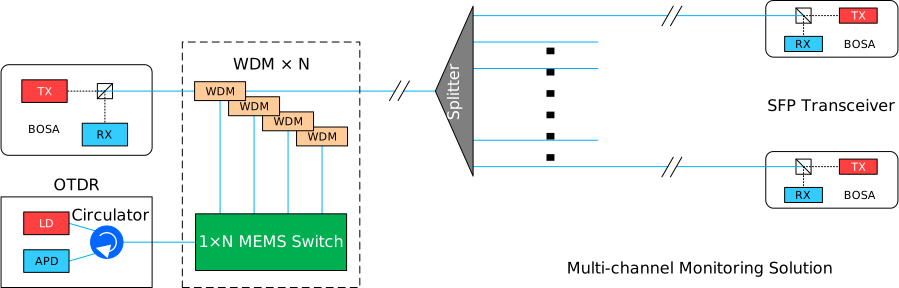
One OTDR, many cables: a circulator-based front end and a 1×N MEMS optical switch let a single instrument poll every fiber under test in turn — the architecture behind remote fiber test systems and multi-channel sensing networks.
Reading the diagram from the instrument out: the OTDR's launch pulse exits through a circulator into a 1×N MEMS switch that selects one cable under test at a time. Beyond the switch, WDMs and splitters fan the polled line out to more fibers, so the channel count grows without adding instruments. Backscatter from whichever fiber is selected retraces the same path; the circulator hands the weak return to the APD receiver, and the SFP transceiver ties the result back to the monitoring controller.
MEMS optical switches — the multiplexing engine. Our 1×N / M×N MEMS switches scale to 128 channels with 10⁹-cycle durability and ±0.05 dB repeatability: at one poll per channel per minute, that is decades of duty with a channel-to-channel loss that never drifts enough to fake an event. The repeatability figure is the whole game — an OTDR judges a cable by comparing one scan against the next, so the switch must re-couple to the same loss on every single actuation. Typical insertion loss of 1.0 dB keeps the power budget intact. PM versions hold polarization for coherent φ-OTDR, and software-defined matrix switches serve multi-instrument test labs.
Circulators — one fiber, both directions. At the interrogator front end, a 3-port circulator steers the launch pulse into the sensing fiber and routes the weak backscatter to the receiver. OTDR is a listed application of our standard and mini circulators — isolation to 40 dB and return loss to 50 dB keep the launch pulse out of the detector, and the mini package (Φ ≤ 3.0 × L ≤ 25 mm) is what fits the front end into an SFP-sized module. For multi-channel interrogators, the 8-in-1 arrayed circulator packs eight independent circulators into an 82 × 45 × 11.5 mm package.
The architecture lives or dies on the baseline. A polling system flags trouble by differencing scans, so every link in the front end must contribute no drift of its own: channel crosstalk of ≥ 40 dB keeps a neighboring fiber's reflection from masquerading as an event, directivity of ≥ 50 dB stops the launch pulse leaking backward into the source, and eight arrayed circulators share one thermal environment instead of drifting eight different ways.
Monitoring hybrids & specialty switches. Tap-PD hybrids (ITPD / TAPD, 1–10% tap ratios, hermetically sealed detectors) supervise launch power in-line so the system knows its own baseline — the hermetic seal is the hard part, since a bare photodiode in a monitoring tap is a humidity failure waiting for the field. Where a polling scheme calls for extreme endurance or latching behavior, magneto-optical switches (>100 billion cycles, no moving mirror and therefore no wear-out curve) and mechanical 1×1 / 1×2 / 2×2 switches cover the special cases.
Qualified for the field. Every device is batch-proven and qualified to Telcordia GR-1221 / GR-1073, with wide-temperature designs, custom wavelengths, fiber types and package outlines as routine practice for sensing programs.

1×N / M×N up to 128 channels — 10⁹-cycle durability and ±0.05 dB repeatability keep a polling system calibrated for its whole service life. PM versions serve coherent φ-OTDR.
View details →3-port standard and mini circulators for OTDR front ends — OTDR is a listed application — plus the 8-in-1 array for multi-channel interrogators and bidi sensing links.
View details →Tap-PD hybrids for in-line power supervision; magneto-optical (>100 billion cycles) and mechanical switches for extreme-endurance polling and protection paths.
View details →All products qualified to Telcordia GR-1221 / GR-1073 reliability programs.
Custom wavelengths, channel counts and package outlines available. Samples ship worldwide.
sales@triple-stone.com
+86 137 0968 6019
OCS-based optical switching for reconfigurable, high-radix AI cluster networks.
Explore →Miniaturized passives for coherent modules, DCI platforms and line systems.
Explore →High-power and PM components for industrial laser systems.
Explore →Batch-proven devices for wind and automotive LiDAR.
Explore →Precision optical components for quantum systems.
Explore →Reliable photonics for space and satellite links.
Explore →Miniaturized custom optics for medical applications.
Explore →Active optical devices — TOSA, ROSA, BOSA — for PON and 5G fronthaul.
Explore →