The circulator: one aperture, both directions. In a coaxial transceiver the circulator routes the outgoing pulse to the scanner and the returning echo to the receiver — the same routing serves pulsed ToF and FMCW architectures alike. PM circulators hold ≥ 22 dB extinction ratio so the polarization state that coherent detection depends on survives the round trip, and our 1550 nm PM 25/300 large-mode-area circulator carries nanosecond pulses up to 10 kW peak — matching the MOPA-with-LMA-output architecture of published all-fiber coherent Doppler wind lidars. Fiber handling at 25/300 class is what makes this device scarce, and it is a line we build in volume.
Tap monitoring closes the loop. A PM tap coupler on the chain samples a few percent of the in-line power, so pump current can be servo-controlled across temperature and aging instead of drifting blind. Our ITPD and TAPD hybrids fold the tap and photodiode into one hermetically sealed package with 1–10% tap ratios — saving splicing points on a transceiver board where every millimeter counts.
One laser, many beams. Multi-beam scanning doesn't need a transceiver per channel. A 1×N PM MEMS optical switch (4/8/16 channels, 10⁹-cycle durability, ± 0.05 dB repeatability) time-shares a single source and receiver across scan lines — wind lidars typically probe 2–8 lines of sight around a fixed cone. The hard part is that the MEMS mirror returns to the same sub-0.05 dB alignment on every actuation, decade after decade; for parallel channel arrays, the 8-in-1 arrayed circulator packs eight independent transmit-receive routers into a single 82 × 45 × 11.5 mm package.
Hybrid integration shrinks the laser engine. Our IWDM folds an isolator and a 940/1550 nm pump-signal WDM into one package; the WITP goes further — WDM, isolator and tap or band-pass filter in a single mini housing, PM or non-PM, rated to 5 kW nanosecond pulses. Co-packaging a ≤ 0.5 dB pump path with a 30 dB-class signal isolator inside one mini housing is the alignment challenge, solved on the same bench that builds our discrete hybrids. Source protection, pump combining and signal monitoring collapse into one device: fewer splices, smaller transceiver modules.
Batch-proven for outdoor duty. Devices are qualified to Telcordia GR-1221 / GR-1073 programs and built for wide-temperature operation with tight lot-to-lot consistency — because a wind or automotive platform in production for years needs every shipped unit to perform identically.
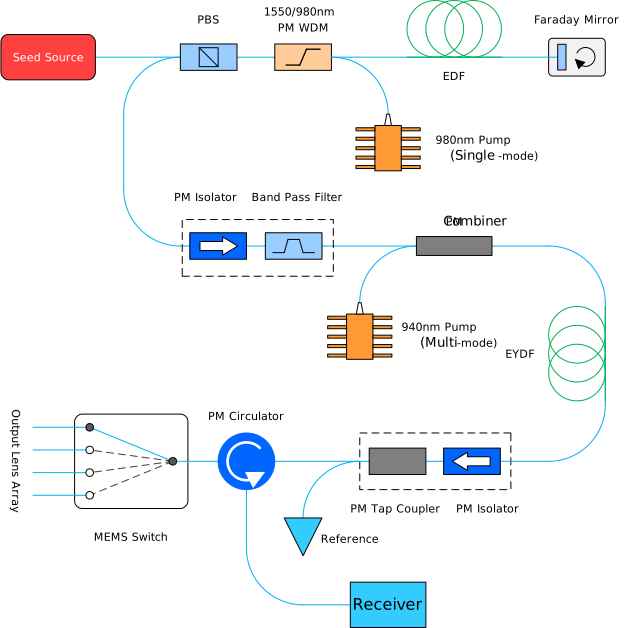
A typical LiDAR fiber-laser transceiver chain — seed source, PM amplification and coaxial transmit/receive routing; the passive devices on the chain are supplied by Triple-Stone.
Reading the diagram: a pulsed seed enters a PBS and a PM WDM injects 980 nm pump into the EDF; a Faraday Mirror folds the gain fiber so the pulse double-passes and leaves polarization-stabilized. The seed meets 940 nm multimode pump light in a PM combiner and is boosted through the EYDF. A PM tap-and-isolator stage samples power and blocks back-reflections before a PM circulator routes the pulse out through the output lens array — and hands the returning echo to the receiver, with a MEMS switch selecting between scan and reference paths.