Home / Applications / AI/HPC Data Center & Cloud
Applications

AI/HPC Data Center & Cloud

OCS-based optical switching for reconfigurable, high-radix AI cluster networks.

Discuss your fabric View OCS models

The Challenge

AI clusters are outgrowing the electrical fabric: cabling, reconfiguration and power become the limiting factors long before the GPUs do.

AI Cluster Scale

GPU node counts keep climbing, and every added electrical spine layer multiplies switch power, latency and cost. The classic oversubscribed fat-tree cannot scale economically to the next cluster generation.

Reconfiguration

Training, fine-tuning and inference each stress the fabric with different traffic patterns. A fixed electrical topology cannot adapt — operators either strand bandwidth or overbuild for the worst case.

Cabling Complexity

High-radix electrical spines translate into thousands of fiber links to install, document and re-patch by hand. At cluster scale, manual re-cabling is slow, error-prone and hard to expand.

How We Fit In

An optical circuit switch replaces part of the electrical spine with a transparent, software-defined optical layer.

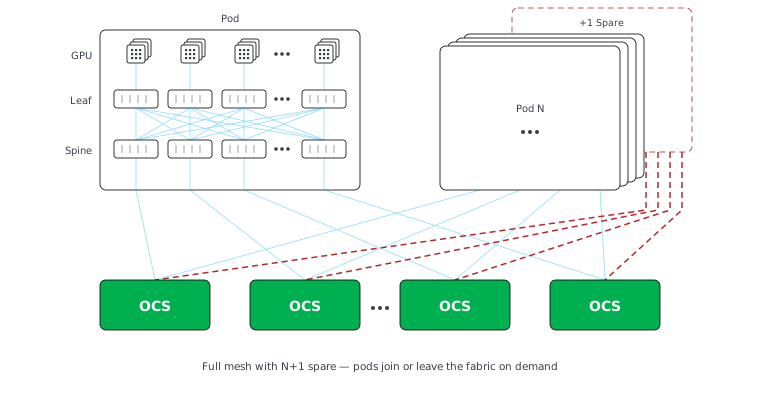
Dragonfly topology with OCS at the spine

OCS at the spine of a Dragonfly fabric — full mesh with N+1 spare.

Where the OCS lives — the data-center fabric. Large AI/HPC clusters still stitch thousands of GPUs together with electrical switch fabrics, doing an optical-to-electrical-to-optical conversion at every hop — power-hungry, and impossible to scale. A MEMS-based OCS from Triple-Stone replaces part of that electrical spine with a transparent optical layer: micro-mirrors steer each incoming fiber straight to an outgoing fiber, creating a direct end-to-end optical path with no OEO conversion and no store-and-forward.

In a Dragonfly topology the OCS sits at the spine, forming a full mesh with N+1 redundancy so pods join or leave the fabric on demand. Because the path is transparent to protocol and data rate, one physical fabric serves today's 400G/800G transceivers and tomorrow's upgrades — and re-provisions in milliseconds, controlled remotely via NETCONF, SNMPv3, TL1, Web GUI and REST API instead of re-patching fiber in the colo.

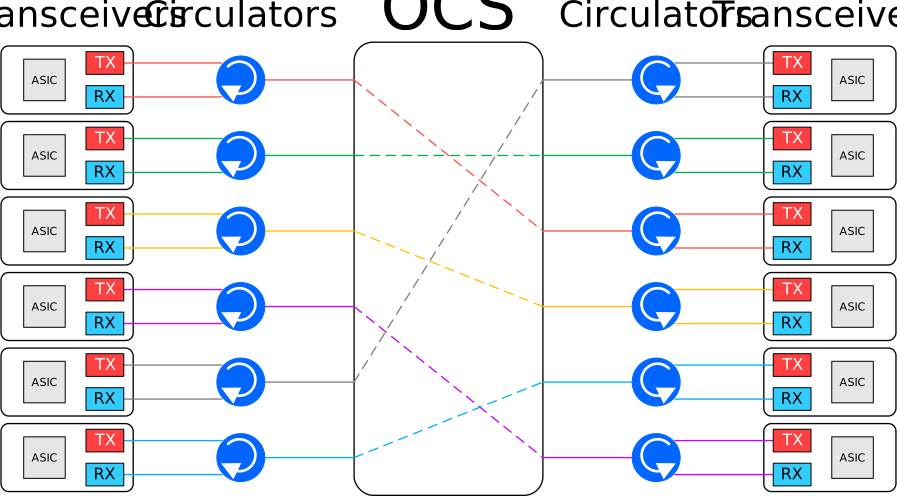
OCS link with circulator separating TX and RX on one fiber

One fiber, both directions — TX/RX separated by a circulator.

One fiber, both directions — circulator pairs. An OCS link should spend as little fiber as possible. Our planar and arrayed circulators let a single fiber carry both directions: the transmit and receive paths are split by port inside the circulator, and with high isolation plus low insertion loss, TX and RX share one fiber — saving fiber and patch-cord cost in a high-radix data-center fabric.

From discrete 3-port devices to arrayed integration, we cover the full circulator range an OCS link needs. The 8-in-1 arrayed circulator packs eight bidirectional paths into one high-density package — the standard companion for OCS ports. At the far end, a 2D optical fiber collimator array couples a high-port OCS into a compact grid, while fiber shuffle chassis re-map high-count links between the OCS and its line cards — all with batch-stable insertion loss and return loss.

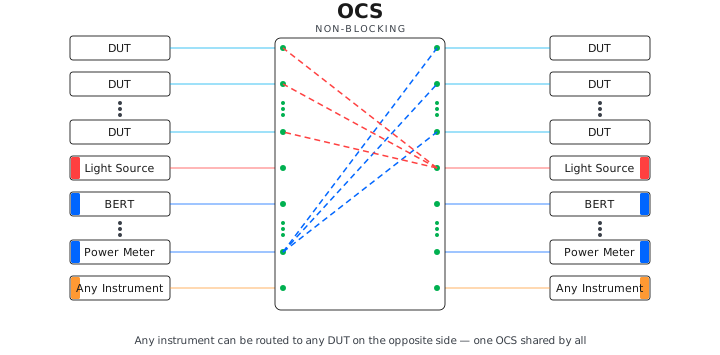
OCS used as test equipment: any instrument routed to any DUT, non-blocking

One OCS shared by every instrument — any-to-any, non-blocking, routed in software.

OCS as test equipment — one switch, shared by every instrument. In a lab or on a production line, devices under test (DUT) and the instruments that measure them — light source, BERT, power meter, any instrument — are normally re-cabled by hand every time the test plan changes. Put a non-blocking OCS in between, and any instrument can be software-routed to any DUT on the opposite side: one OCS shared by every test station.

Instrument ports and DUT ports line up one to one, and the crossing paths are built and torn down in software, so the test topology is configured once and re-used across many devices. It is the same optical-switching core that drives a data-center fabric — here it switches test resources instead. Our OCS is developed fully in-house, including the core 2D FAU collimator arrays, so the any-to-any paths hold stable insertion loss and stay reliable as long-term test equipment.

Products for This Application

300 × 300 OCS

MEMS-based, non-blocking optical circuit switching for AI-scale data center interconnects — in mass production, fully software-controlled via NETCONF and REST API.

View details →

8-in-1 Circulator

Arrayed circulator integrating 8 independent circulators — the standard bidirectional companion for OCS links.

View details →

Fiber Shuffle

Shuffle chassis and flexible boards for re-mapping high-count fiber links between OCS and line cards.

View details →
1,500+Employees
57,000 m²Floor Space
4Manufacturing Bases
500+Customers
3R&D Centers
62Patents

All products qualified to Telcordia GR-1221 / GR-1073 reliability programs.

Building an AI fabric?
Tell us your port count and timeline.

Evaluation units ship worldwide. Custom wavelength range, connector type and chassis options available.

sales@triple-stone.com
+86 137 0968 6019

Verification code

Other Applications