Precision passive devices for the narrow-linewidth laser systems behind neutral-atom quantum computing, quantum precision measurement and photonic quantum systems — where laser frequency stability is everything.
Discuss your laser system View precision componentsQuantum systems manipulate and confine atoms and photons with light — and that light must be controlled to extraordinary precision. The passive devices inside the laser chain set the floor for what the whole system can achieve.
Neutral-atom computing and quantum sensing work only when lasers sit exactly on atomic transitions — rubidium at 780/795 nm, metastable helium at 1083 nm — with narrow linewidths and long-term frequency locks. Drift, jitter or phase noise in the laser chain lands directly on qubit fidelity and measurement accuracy.
Narrow-linewidth sources are easily destabilized: even weak back-reflections re-entering the cavity cause mode hops and frequency jitter, and amplified spontaneous emission from amplifier stages contaminates the atomic line. Isolation and spectral filtering along the chain are not optional.
Quantum laser chains run far off the telecom grid: non-standard wavelengths, polarization-maintaining and large-mode-area fibers, power levels from milliwatts to tens of watts — usually in small batches. Suppliers must be willing to build to the experiment, not the catalog.
Triple-Stone supplies the passive device layer inside narrow-linewidth laser systems — the isolators, taps, filters and hybrids that keep the laser stable from seed to atom.
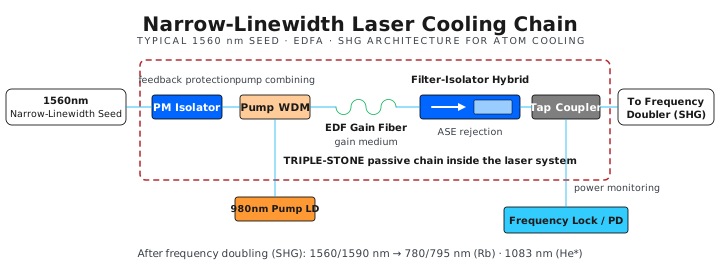
Typical narrow-linewidth laser chain for atom cooling and manipulation — the passive device section inside the dashed frame is built and supplied by Triple-Stone.
Light starts as a 1560 nm narrow-linewidth seed and immediately passes a PM isolator that blocks any reflection from re-entering the source. A pump WDM then combines 980 nm pump light from a laser diode with the signal along erbium-doped gain fiber; after amplification, a filter-isolator hybrid strips ASE and out-of-band light. A tap coupler sends a small fraction to the frequency-lock power monitor, and the clean signal continues to the frequency doubler. The dashed frame — every device from isolator to tap — is built and supplied by Triple-Stone.
High-isolation PM isolators & filter-isolator hybrids. Single- and dual-stage PM isolators keep back-reflections out of narrow-linewidth seeds and amplifier chains — fast-axis-blocked, with high isolation and extinction ratio held across temperature. Back-reflection is what turns a quiet seed into a mode-hopping one, so isolation here is the first line of defense for the frequency stability the whole experiment depends on. Our filter-isolator hybrids add a narrowband filter in the same package, stripping ASE and out-of-band light before it can reach the atoms.
Precision tap monitoring. Tap couplers and tap-PD hybrids sample a small, accurately known fraction of the line for closed-loop power stabilization and diagnostics — the ratio set to your power budget, with the coupling accuracy a control loop needs to hold the lock — without disturbing the main path.
Narrowband filtering & pump combining. Custom narrowband filters with sub-nanometer center-wavelength accuracy clean up seed spectra — ASE that survives amplification would otherwise sit on the atomic line and blur the transition — while filter WDMs combine pump and signal bands (976/1020 nm-class pump combining for Yb-doped amplifier stages, for example) on both PM and standard fibers. Hybrid builds fold the isolator in with the WDM, so every saved fusion splice is one less potential back-reflection site.
Any wavelength, built for quantum. We routinely build off the telecom grid: 1560/1590 nm devices for frequency-doubled rubidium chains (780/795 nm cooling and pumping), 1083 nm for metastable helium, and other non-standard bands — on PM, large-mode-area and high-power variants, in the small batches research and pilot systems actually need. Off-grid means each device is engineered from its first design rule for that wavelength, not adapted from a telecom part — fiber type, package and specifications all start from your transition, not from a catalog page.
The whole chain, on your block diagram. Whatever the experiment — 1560 nm seeds doubled to rubidium lines, 1083 nm helium chains, a Yb amplifier breadboard — we deliver the passive section as one integrated, tested set: every isolator, WDM, filter hybrid and tap on your schematic, spliced and qualified together, and documented for the small-batch builds research and pilot systems need.

Single/dual-stage PM isolators that shield narrow-linewidth lasers from back-reflection — plus high-power and large-mode-area versions and PM circulators for routing inside the laser chain.
View details →Tap couplers and tap-PD hybrids for closed-loop laser power monitoring — accurate, highly asymmetric split ratios, custom wavelengths, PM and standard fiber options.
View details →Filter-isolator hybrids, IWDM/WITP-style integrated devices and custom narrowband filters — filter, isolation, tap and WDM functions combined in one small package.
View details →All products qualified to Telcordia GR-1221 / GR-1073 reliability programs.
Share your laser wavelengths and system architecture — we design and build the passive layer around them, and we are used to working under NDA. Custom wavelengths, fiber types and package outlines available; small batches welcome. Samples ship worldwide.
sales@triple-stone.com
+86 137 0968 6019
OCS-based optical switching for reconfigurable, high-radix AI cluster networks.
Explore →Miniaturized components for coherent modules and line systems.
Explore →Fiber-optic devices for distributed sensing and measurement.
Explore →High-power and PM components for industrial laser systems.
Explore →Batch-proven devices for wind and automotive LiDAR.
Explore →Reliable photonics for space and satellite links.
Explore →Miniaturized custom optics for medical applications.
Explore →Active optical devices — TOSA, ROSA, BOSA — for PON and 5G fronthaul.
Explore →