The high-power passive layer inside industrial fiber lasers: isolators to 100 W in-line and 500 W free-space, pump & signal combiners, laser WDMs and hybrids — built to survive the back-reflection that kills lasers.
Discuss your laser design View high-power isolatorsBack-reflection is the No.1 killer of fiber lasers — and as cutting and welding systems climb into the multi-kW era, every passive in the optical path becomes a survival-critical part.
Copper and aluminum reflect up to ~90% of 1 µm laser light at room temperature. In cutting and welding, that power travels straight back up the delivery fiber into the amplifier chain — and can burn out the seed and pump diodes in a single bad shot. An output isolator is not an accessory; isolation and power rating must scale together, or the laser dies.
Industrial systems have moved from hundreds of watts to multi-kW cutting and welding, with laser cleaning and additive manufacturing pulling the same way. Every passive in the path now faces 100 W-class CW loads and 10 kW-class ns pulse peaks — and every absorbed watt becomes heat. Thermal design, not margin, now defines the component.
Yb at 1030–1080 nm for cutting and welding, Er at 1550 nm for eye-safe systems, Tm at 1940/1950 nm for medical and plastics processing — each band needs its own magneto-optic and fiber design. Laser OEMs need a supplier who covers all three — and builds to a drawing where the catalog stops.
Triple-Stone builds the high-power passive layer along the whole fiber-laser chain — from the seed line to the processing head. Here is what actually makes these devices hard, and how far our matrix goes.
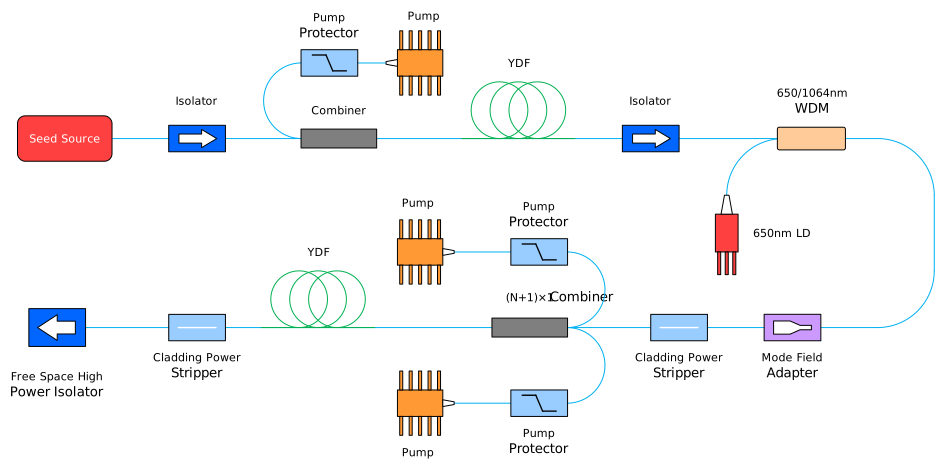
A typical multi-stage Yb-doped fiber laser (MOPA) chain: seed → isolator → pump combiner → YDF gain stages → cladding power stripper → free-space output. Triple-Stone supplies the isolators, pump & signal combiner and laser WDMs along this chain — in-line to 100 W, fiber-to-free-space to 500 W.
Walking the chain: the seed passes an isolator into the first pump-and-signal combiner, and a short YDF stage lifts it to drive level. A second isolator protects the stage, and a 650/1064 nm WDM adds a red pilot beam on the same fiber for alignment. The main (N+1)×1 combiner then fuses multiple pump diodes — each behind a pump protector — into the power YDF. Downstream, a cladding power stripper sheds unabsorbed pump light, a mode-field adapter matches the delivery fiber, and a free-space high-power isolator closes the chain at the output window.
Stage-to-stage and output isolation. In a MOPA chain, any reflection from downstream travels back upstream with gain behind it. Our in-line isolators guard seed and pre-amp stages from 300 mW up to 100 W CW, on standard, PM or large-mode-area fiber. At the output, fiber-to-free-space isolators expand the beam to a collimated 7 mm output and hold ≥ 28–30 dB isolation at 60 / 120 / 250 / 500 W — the 500 W version is water-cooled, rated for 50 kW ns pulse peaks, and ships with a specified reverse-power handling for exactly the back-reflected shot it exists to stop. Two things make high-power isolation hard: the magneto-optic crystal has to stay aligned while kilowatts of heat move through it, and the isolator must survive the very reflection it exists to block — hence a 5 W continuous / 20 W short-duration reverse-power rating on the 500 W unit.
Pump and gain-chain passives. Our 50 W pump & signal combiner couples 976 nm pump light into the cladding of LMA double-clad fiber at ≥ 90% efficiency while passing the 1064 nm signal at ≤ 0.5 dB loss — fusing a 105/125 µm multimode pump port onto LMA gain fiber at that efficiency is taper-and-fuse work we run at production scale. Around it: fused PM couplers, polarization beam combiners/splitters, pump & signal WDMs, and high-power PM tap couplers to 100 W for in-line power monitoring.
Pulsed and high-power variants. Nanosecond-pulse versions are rated to 10 kW peak across the line — 50 kW on the 500 W free-space isolator, and 250 kW ps peak on the 1950 nm 100 W unit. High-power circulators cover 760–1940 nm, with LMA / PLMA large-mode-area fiber options to preserve beam quality at power.
Hybrid integration. Laser builders keep shrinking cavities, so we fold functions into one mini package: IWDM (isolator + WDM), WITP (WDM + isolator + tap or band-pass filter) and ITPD (isolator + tap + PD). Fewer splices, fewer failure points — one qualified part instead of three.
Honest about the chain. The cladding power stripper, the pump protectors and the mode-field adapter in the diagram are not our products — the laser builder sources those where they choose. Everything fiber-mated around them is: seed and stage isolators, the pump & signal combiner, laser WDMs and tap couplers, and the free-space output isolator — all qualified on the same LMA fiber types the rest of the chain runs on, from 10/125 up to 50/400 µm core.

The ace card: in-line isolators from 300 mW to 100 W (1064 / 1550 / 1940 nm), fiber-to-free-space output isolators to 500 W with water cooling — ns pulse peaks to 50 kW, reverse-power handling specified.
View details →Pump & signal combiners, high-power PM tap couplers, PBC / PBS and laser WDMs — organized by working band: 1064, 1550 and 1940/1950 nm.
View details →High-power circulators across 760–1940 nm, plus fused, filter and high-power PM filter WDMs spanning 532–1950 nm for pump/signal management.
View details → Laser WDM →All products qualified to Telcordia GR-1221 / GR-1073 reliability programs.
100 W in-line, 500 W free-space, ns pulses to 50 kW — and custom wavelengths, fibers and packages beyond the catalog. Samples ship worldwide.
sales@triple-stone.com
+86 137 0968 6019
OCS-based optical switching for reconfigurable, high-radix AI cluster networks.
Explore →Miniaturized hybrid and PM components for coherent modules and line systems.
Explore →Fiber-optic devices for distributed sensing and measurement.
Explore →Batch-proven devices for wind and automotive LiDAR.
Explore →Precision optical components for quantum systems.
Explore →Reliable photonics for space and satellite links.
Explore →Miniaturized custom optics for medical applications.
Explore →Active optical devices — TOSA, ROSA, BOSA — for PON and 5G fronthaul.
Explore →