Home / Applications / Coherent Telecom, DCI & Long-Haul
Applications

Coherent Telecom, DCI & Long-Haul

Miniaturized, Telcordia-qualified passive components inside coherent modules, DCI platforms and long-haul line systems.

Discuss your line system View coherent components

The Challenge

Coherent optics are moving from the backbone into every metro and DCI link — and the passive layer has to shrink without giving up performance.

Coherent Everywhere

As coherent migration pushes toward 800G and beyond, modules pack more optical functions into less space. Every passive inside must get smaller while holding tighter wavelength and loss budgets.

DCI Density

Metro DCI platforms scale by packing more channels per rack unit. Monitoring, equalization and gain-flattening functions multiply — and each one must fit the module outline, not the other way round.

Long-Haul Margins

Over dozens of amplified spans, every fraction of a dB of insertion loss and every trace of PDL eats into OSNR margin. Passives are small parts with an outsized effect on reach.

How We Fit In

Triple-Stone supplies the passive optical layer inside coherent modules and along the line — wherever loss, polarization and size matter.

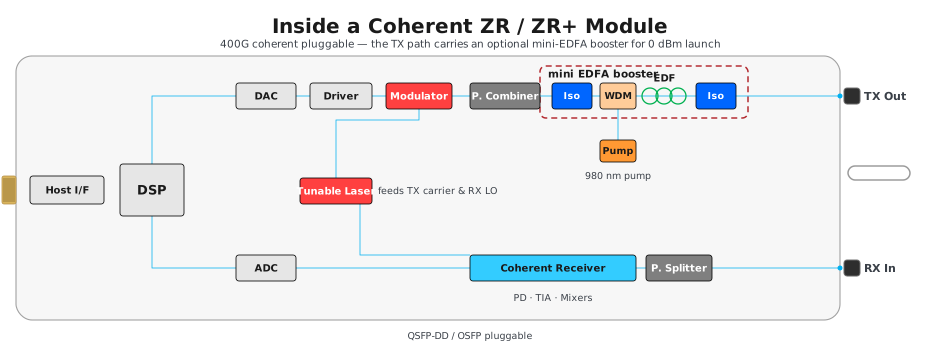
Coherent ZR/ZR+ module architecture: host electrical interface to DSP; TX path through DAC, driver, IQ modulator and polarization combiner into a highlighted single-stage mini EDFA booster; RX path through polarization splitter and coherent receiver back to the ADC; tunable laser feeds TX carrier and RX local oscillator

Inside a coherent ZR/ZR+ module, the mini EDFA (highlighted) sits on the TX output only — it boosts the modulated signal to 0 dBm launch, while the RX path returns unamplified through the polarization splitter and coherent receiver.

Read the module left to right. The host electrical interface drives a DSP, whose TX path runs DAC → driver → IQ modulator, combines both polarizations, then passes a single-stage mini EDFA booster — input isolator, 980/1550 nm pump WDM, erbium-doped coil and output isolator — before the TX fiber. On the RX side, light enters a polarization splitter and a coherent receiver (PDs, TIAs and mixers), where the same tunable laser supplies the local oscillator; the recovered signal returns through the ADC to the DSP. The red frame marks the passive core of the booster — the isolators, pump WDM and erbium coil inside it are all Triple-Stone passives; the orange pump sits outside the frame and is the one active part of the module's single amplifier.

A booster, not a line amp. The mini EDFA inside a ZR/ZR+ pluggable is a single gain stage — an input isolator, a 980/1550 nm pump WDM, a short erbium-doped coil and an output isolator, driven by one 980 nm pump. It lifts the modulated TX signal to 0 dBm launch for multi-span ROADM reach, and that is all it must do: because it amplifies a single channel, it needs no second stage, no gain-flattening filter and no VOA — unlike a line-side EDFA, which shapes an entire DWDM spectrum.

Everything in that booster is a Triple-Stone passive. The isolators and pump WDMs are folded into 2-in-1 hybrids to fit the module outline, and PM variants hold extinction ratio on the polarization-sensitive TX path. When the design does need gain shaping, our gain-flattening filters and VOAs bring the same miniaturization onto the line card.

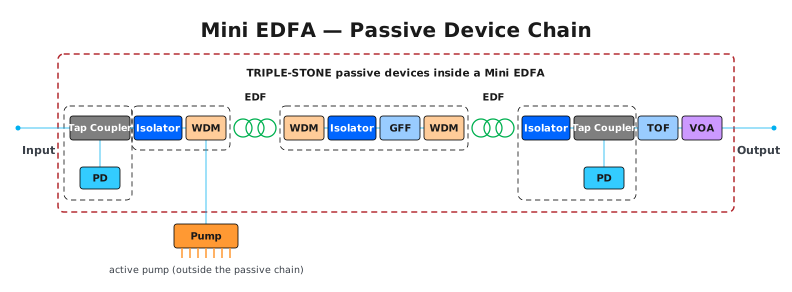
Two-stage Mini EDFA passive device chain: tap/PD input and output monitors, isolators, pump WDM, erbium-doped fiber, GFF, TOF and VOA, with dashed frames marking same-package hybrid devices

A typical Mini EDFA passive chain inside the module — tap/PD monitors, isolators, pump WDMs, EDF, GFF, TOF and VOA (dashed frames mark same-package hybrids). Triple-Stone supplies every passive on this chain.

Read the chain left to right. Signal enters at the Input, where a tap + PD samples power. An isolator blocks back-reflections while a WDM couples in the pump for the first gain stage. Between stages, a WDM + isolator + GFF + WDM assembly stops oscillation and flattens gain. After the second EDF, an isolator and tap + PD monitor the output, a TOF removes ASE and a VOA sets launch power. Dashed frames mark functions fused into one hybrid — one package replacing a row of discrete parts.

Coherent transmission is now the default for DCI and long-haul links — and almost every coherent link, from line amplifiers to ZR-class pluggable modules, depends on an erbium-doped fiber amplifier (EDFA). The EDFA gain block is where Triple-Stone's passives live: isolators, WDM couplers, gain-flattening filters, tap monitors and VOAs, packaged as miniaturized hybrids.

EDFA building blocks. In line and multi-stage EDFAs, our IWDM (isolator + 1550/980 nm WDM), IGFF (isolator + gain-flattening filter) and WIGW hybrids collapse the pump-coupling, isolation and gain-flattening stages into single spliced components — while tap PDs monitor input/output power and MEMS VOAs equalize the DWDM spectrum.

EDFA inside ZR modules. As 800G-class ZR/ZR+ pluggables integrate a micro-EDFA on the board, space is tighter than ever: our folded IWDM and 2-in-1 dual isolator+WDM hybrids cut coiling and splicing points to fit a complete mini-EDFA inside the module outline — with PM variants holding extinction ratio for polarization-sensitive paths, all qualified to Telcordia GR-1221 / GR-1073.

Not every tier needs the EDFA, though: at 400G and below, ZR/ZR+ modules carry PMTC polarization splitters/combiners as their passive core; a Mini EDFA joins only in higher-rate, longer-reach designs. The rule is the same — the faster the module and tighter its board, the smaller and more integrated the passives. Our miniaturization roadmap runs from standard hybrids (ITPD 5.5×25 mm) to miniaturized 2.6×22 mm, ultra-mini 1.4×17 mm and folded 1.8×12 mm, up to N-in-1 arrays. Share your module outline — we design the chain to fit.

Miniaturization is not a new ask for us — it is a decade of shipping smaller and smaller hybrids. Isolator and WDM functions that began as discrete parts in a 5.5×25 mm package now ship at 2.6×22 mm, in ultra-mini 1.4×17 mm and folded 1.8×12 mm outlines, and as N-in-1 arrays replacing a whole row of devices. When the spec gets tighter, we are not solving a new geometry — we are re-running a roadmap we have shipped for years.

Multi-rail EDFA. The figure above follows one mini-EDFA inside a module; outside it, line-card and subsystem designs are going multi-rail — sharing amplification across parallel links to save space and pump power per rail. Arrayed passives carry the trend: 4-in-1 isolators pack four paths into a single-isolator footprint (≤Φ2.2 × L≤25 mm); a 2-in-1 IWDM merges two isolator+WDM pairs in one package; and 8-in-1 / 2-in-1 circulators bring the same consolidation to mini and multi-way optical amplification systems. Multi-port does not mean circulator-only — N-in-1 thinking spans our isolator, WDM and hybrid lines alike.

Products for This Application

Hybrid Components

2-in-1 mini IWDM, folded IWDM, isolator+WDM and isolator+GFF hybrids for EDFA and coherent integration — Φ ≤ 3.0 mm ultra-mini packages.

View details →

Tap PD & Monitoring

Mini Tap PD, ITPD and Tap+PD hybrids for optical power monitoring inside amplifiers and coherent modules.

View details →

MEMS VOA

MEMS-based variable optical attenuators for per-channel equalization across DWDM lineups.

View details →

PM Components

PM isolators and hybrids, PMTC / PBS devices for polarization-sensitive coherent optics.

View details →
1,500+Employees
57,000 m²Floor Space
4Manufacturing Bases
500+Customers
3R&D Centers
62Patents

All products qualified to Telcordia GR-1221 / GR-1073 reliability programs.

Specifying a coherent module
or line system? Tell us.

Custom wavelength plans, package outlines and hybrid combinations available. Samples ship worldwide.

sales@triple-stone.com
+86 137 0968 6019

Verification code

Other Applications