Home / Applications / Medical Photonics
Applications

Medical Photonics

Miniaturized, custom-built passive optical devices for medical systems — up to complete swept-source OCT optical engines: couplers, circulators, FBG, VOA and delay-fiber interferometers integrated and delivered as one module.

Discuss your optical design View connectivity products

The Challenge

Medical imaging systems — swept-source OCT above all — are among the most demanding optical instruments ever built: an interferometric engine where every coupler, circulator and meter of fiber shapes the final image.

Interferometers Forgive Nothing

In an OCT engine, image quality is decided by the passive optical chain: coupler split-ratio accuracy, arm-to-arm balance, isolation and return loss all land directly on the noise floor. There is no software fix for a sloppy interferometer.

Consistency in Volume Production

Diagnostic platforms stay in production for years, and every unit must image like the first. Optical devices need tight lot-to-lot consistency in insertion loss, isolation and split ratio — delivered at volume, year after year.

One Engine, Too Many Vendors

A single swept-source engine packs couplers, circulators, FBGs, a VOA and precision delay fiber into one interferometric module. Sourcing each part from a different supplier multiplies interface risk — and few component makers can deliver the whole subsystem.

How We Fit In

Triple-Stone can take over the entire interferometric optical engine of a medical system — from a single custom coupler to a complete swept-source OCT module, built to your block diagram.

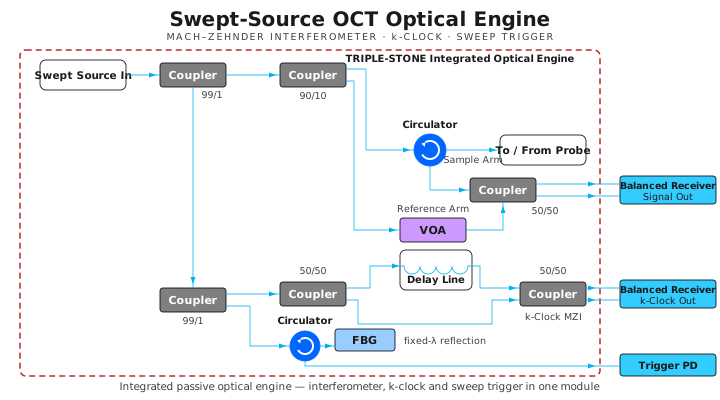
Typical swept-source OCT optical engine architecture: source leveling, sample and reference arms, k-clock interferometer with precision delay line, and FBG sweep trigger — all passive devices integrated by Triple-Stone

Typical swept-source OCT optical engine architecture — couplers, circulators, sweep-trigger FBGs, VOA and precision delay lines, integrated and delivered by Triple-Stone as a single module.

Light from the swept source enters at the left, and a tree of couplers divides it between a sample arm — routed through a mini circulator to the probe, whose echo returns through the same circulator — and a reference arm balanced by a VOA. The arms recombine at the signal balanced receiver. A k-clock Mach–Zehnder with a precision delay line sets the sampling clock, and a fixed-wavelength FBG reflection triggers the start of every A-scan. Every device shown — couplers, circulators, VOA, delay line, FBG — is built by Triple-Stone.

Custom couplers, any split ratio. Even, asymmetric or anything in between — fused and micro-optic couplers built to your exact ratio, wavelength and package. An interferometer is only as good as the balance of its two arms, so ratio accuracy and low excess loss are where image quality starts — any imbalance here lands straight on the noise floor of the image. Tap couplers sample source power for monitoring and the k-clock reference without disturbing the main path.

Mini & ultra-mini circulators. Transmit and receive routed on one fiber with high isolation — in packages small enough to sit at the probe end of endoscopic and catheter-based OCT designs. That is where space is tightest and isolation matters most: the returning sample echo shares the launch fiber, and leakage between the two directions lands directly in the image.

Precision held at volume. Tight insertion-loss, return-loss, isolation and split-ratio tolerances with proven lot-to-lot consistency — because a medical platform in production for years needs every shipped engine to perform identically. Each device is measured against the same acceptance criteria the first article met, on the same test stations, for the life of the program.

Whole-engine integration. A swept-source OCT engine typically packs couplers, circulators, a reference-arm VOA, precision delay lines and trigger FBGs into one interferometric module. Send us your system block diagram; we return a spliced, tested optical subsystem — every fusion splice, pigtail and interface verified as a single unit, not a pile of parts.

k-clock and sweep trigger built in. Beyond the sample and reference arms, a production OCT engine carries a k-clock interferometer — a fixed precision delay line that turns the wavelength sweep into equally spaced optical-frequency samples — and a wavelength trigger that marks the start of every A-scan. Both ride on the same passive devices we supply: a fiber delay line, a fixed-wavelength FBG reflection, and the couplers and circulators that route them. Get the clocking wrong and the image warps; let the trigger jitter and A-scans stop aligning. These small parts decide whether the engine images or merely sweeps.

Products for This Application

Optical Circulators

Mini and ultra-mini circulators route source light to the probe and the sample echo back to the balanced detector — high isolation, probe-end size, full OCT bands.

View details →

Couplers & Tap Hybrids

Custom split ratios — even or asymmetric — for interferometer arms, k-clock generation and power monitoring. Low excess loss, tight ratio accuracy, unit-to-unit repeatability.

View details →

Hybrid Components

Isolator, WDM, tap and PD functions combined in one ultra-small package — the same integration discipline we apply to a complete OCT engine module.

View details →
1,500+Employees
57,000 m²Floor Space
4Manufacturing Bases
500+Customers
3R&D Centers
62Patents

All products qualified to Telcordia GR-1221 / GR-1073 reliability programs.

Designing an OCT engine
or a diagnostic optical system? Send us your block diagram.

From a single custom coupler to the complete interferometer module — custom wavelengths, split ratios and package outlines available. Samples ship worldwide.

sales@triple-stone.com
+86 137 0968 6019

Verification code

Other Applications