Home / Applications / Access Network
Applications

Access Network

Active optical devices — TOSA, ROSA, BOSA and hermetic assemblies — for PON, 5G fronthaul and enterprise access networks.

Discuss your access network View active access products

The Challenge

Access networks are the last mile — and the most cost-sensitive. Every transceiver must deliver carrier-grade performance at volume-scale pricing.

Volume Production at Scale

PON and 5G fronthaul deployments run into millions of ports — a 1:64 TDM-PON split means sixty-four ONUs per OLT port, each carrying a BOSA. Optical sub-assemblies must be produced in high volume with consistent insertion loss, wavelength accuracy and reliability — batch after batch.

Hermetic Packaging for Harsh Environments

Outdoor access equipment — street cabinets, pole-mounted remote nodes, base stations — subjects optics to temperature swings, humidity and condensation. Hermetic sealing is not optional.

Speed to Market

Access network standards evolve fast — 10G PON to 25G/50G PON, new wavelength plans, new form factors. Component suppliers must keep pace with rapid design cycles and short qualification windows.

How We Fit In

Triple-Stone supplies the active optical building blocks inside access-network transceivers — the TOSA, ROSA and BOSA at the heart of every PON port, the Filter WDM that stacks PON generations on one fiber, and the hermetic packaging that keeps them alive outdoors.

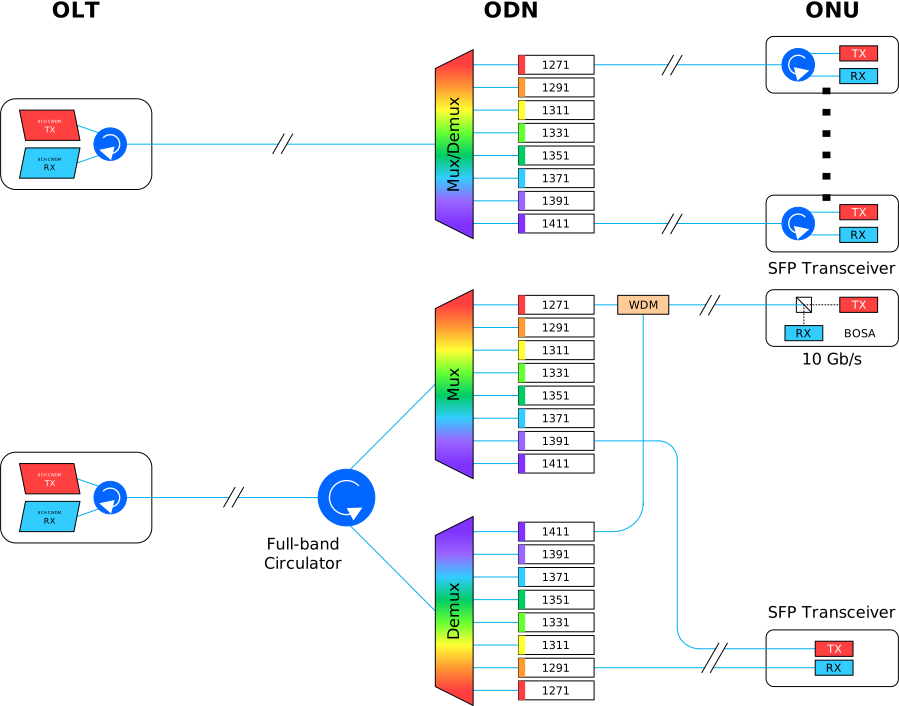
WDM-PON gives every ONU its own wavelength. Where classic TDM-PON time-shares one wavelength across dozens of ONUs, WDM-PON carves the spectrum so each subscriber keeps a dedicated lane — no burst-mode scheduling. It multiplies the capacity of a single access fiber without laying new fiber. In the 8-channel scheme shown, each OLT transceiver runs its own 10 Gb/s lane on the CWDM grid — 1271–1411 nm — all muxed onto one ODN fiber and demuxed at the ONU. One fiber, eight independent services.

The mux/demux core is a Z-block optical engine: a compact stack of thin-film filters that folds eight wavelengths into one port. Our Filter WDM and IWDM lines deliver this function from discrete filter components to folded mini hybrid packages — with isolator, tap and PD options integrated for OLT line cards.

On that same fiber, transmit and receive directions are separated by a circulator — why our full-band circulators sit at the OLT head. Qualified across the whole CWDM window, they keep TX and RX on one fiber with high isolation and low insertion loss; high-power and PM variants extend the same topology to amplified and polarization-sensitive links.

Around this passive core, the OLT/ONU optics are completed by our TOSA, ROSA and BOSA sub-assemblies — 10G/25G lasers and PIN/APD detectors — and protected by hermetic receptacles and butterfly packages for outdoor enclosures. Every element is qualified to Telcordia GR-1221 / GR-468.

8-channel CWDM WDM-PON: OLT 8CH CWDM TX mux and RX demux, full-band circulator, ODN and ONU BOSA

8 × 10 Gb/s WDM-PON on one fiber — OLT 8CH CWDM mux/demux and full-band circulator (Triple-Stone components), ODN, ONU BOSA.

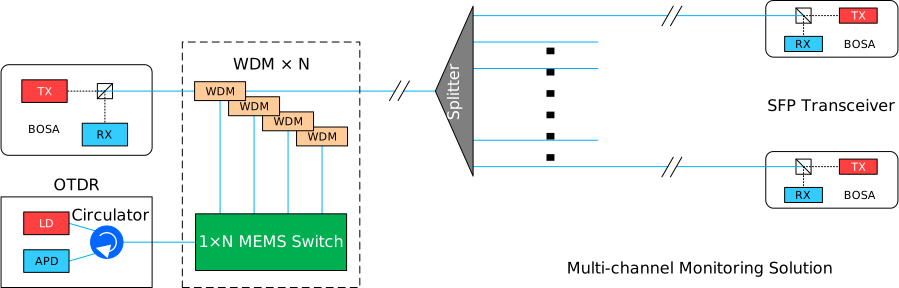
TDM-PON: one fiber, dozens of subscribers. The point-to-multipoint networks that fill most of the access plant start with a single OLT port driving a tree of ONUs through a passive optical splitter — 1:32, 1:64, up to 1:256 — with downstream and upstream on different wavelengths so one fiber carries both directions. Every ONU therefore holds one BOSA, a bidirectional sub-assembly that transmits and receives through the same port; the OLT side pairs a high-power TOSA with a high-sensitivity ROSA/APD. Beside that traffic path, operators hang a monitoring layer on the OLT — a MEMS optical switch plus an OTDR — so one instrument polls the health of every fiber in the plant.

The same PON is moving into the enterprise. Passive Optical LAN (POL) replaces floors of Ethernet switches with a passive ODN, pulling fiber to the desktop and to the room. There is no active electronics in the riser to power, cool or maintain — the fiber plant runs silent from the OLT to every office — which is why greenfield campuses and smart buildings are standardizing on PON instead of three-tier switching.

Three generations share one ODN. GPON (1490 nm down / 1310 nm up), XGS-PON (1577 / 1270 nm) and 50G PON (1342 nm down; upstream 1260–1280, 1290–1310 or 1284–1288 nm) coexist on the same fiber by wavelength — an operator adds a next-generation line card without touching the splitter. That coexistence is a Filter WDM job: thin-film combiners fold the generation bands onto one fiber at the OLT, the same mux/demux discipline our WDM lines build every day, with our IWDM hybrids adding isolator and monitor functions for OLT line cards.

Built for the volume and the elements. A 1:64 split means sixty-four BOSAs per OLT port — access optics ship in the tens of millions. Our TOSA/ROSA/BOSA lines run at that scale with consistent wavelength accuracy and Telcordia GR-1221 / GR-468 qualification, and hermetic receptacles seal the outdoor ONUs, street cabinets and pole-mounted OLTs against humidity and condensation.

Multi-channel PON monitoring: one OTDR launches through a circulator front end and a 1×N MEMS optical switch polls each branch, WDM couplers inject the probe light into the passive splitter's fat tree down to N SFP/BOSA endpoints

Multi-channel monitoring on a PON: an OTDR launches through a circulator front end, a 1×N MEMS switch polls each branch in turn, and WDM couplers inject the probe light into the splitter's fat tree — down to every SFP/BOSA. Triple-Stone supplies the BOSA, circulator, MEMS switch and WDM; the splitter is passive ODN.

Reading the diagram from the instrument out: an OTDR sends a short pulse of probe light through a circulator into a 1×N MEMS optical switch, which aims it at one branch of the PON at a time. WDM couplers fold that probe wavelength onto each fiber so it travels the same path as the traffic, through the passive splitter's fat tree and out toward the N SFP/BOSA endpoints. A break or a bad connector reflects light back; the return retraces the same route and the circulator hands the weak echo to the receiver, so one OTDR spots a fault anywhere in the plant without rolling a truck. Triple-Stone supplies the BOSA, circulators, MEMS switch and WDM — the splitter itself is passive ODN glass that we do not supply.

Products for This Application

TOSA

10G 1310 nm DFB LC TOSA and 25G CWDM DFB LC TOSA — the transmitter core for PON OLT and 5G fronthaul SFP28 modules.

View details →

ROSA

10G PIN-TIA and 25G APD ROSA with LC receptacle — high-sensitivity receivers for access-network transceivers.

View details →

BOSA

10G/25G 1270&1330 nm series LC BOSA — integrated bidirectional sub-assembly for symmetrical PON links.

View details →

Full-band Circulator

3-port full-band circulators spanning the CWDM window — single-fiber TX/RX separation for OLT line cards, with high-power and PM variants for amplified links.

View details →

Hermetic & Receptacle

Hermetic adapter, connector, butterfly-packaged laser and feedthrough — sealed optical interfaces for outdoor and harsh-environment access equipment.

View details →

Filter WDM

Thin-film filter WDMs folding GPON, XGS-PON and 50G PON onto one ODN fiber — coexistence on one fiber, plus IWDM hybrids for OLT line cards.

View details →
1,500+Employees
57,000 m²Floor Space
4Manufacturing Bases
500+Customers
3R&D Centers
62Patents

All products qualified to Telcordia GR-1221 / GR-1073 reliability programs. Active devices qualified to GR-468.

Building an access network?
Tell us your wavelength and volume.

Custom wavelength plans, receptacle types and hermetic packaging available. Samples ship worldwide.

sales@triple-stone.com
+86 137 0968 6019

Verification code

Other Applications