Passive devices for 1550 nm optical terminals in inter-satellite and space-to-ground links — EDFA amplification, back-reflection suppression, in-line power monitoring and receive filtering, with package and validation options evaluated for the mission environment.
Discuss your terminal design View high-reliability componentsSpace optical terminals must maintain long-distance links with weak received signals while tolerating launch vibration, vacuum thermal cycling and radiation. Device selection must balance optical performance, mission conditions and production consistency.
On orbit there is little convective cooling and no routine service access. Outgassing can contaminate precision optics, thermal cycling and launch vibration affect alignment, and radiation-induced attenuation must be evaluated for fibers and EDF. Ground reliability evidence is a starting point; mission-specific testing still needs to be defined.
Receive signals are weak, so the transmit chain needs sufficient amplification while the receive side limits insertion loss and background noise. A 1550 nm architecture can leverage mature EDFA technology and the telecom ecosystem, but wavelength and routing still depend on the terminal design.
Space optical communications are moving from demonstration missions to interoperable constellation deployments. In production, devices must meet the same optical specifications from lot to lot, with traceable test and screening records.
Triple-Stone supplies passive devices inside 1550 nm optical terminals for transmit amplification, receive filtering, in-line monitoring and optical protection. Materials, packages and validation options can be evaluated against vacuum, thermal-cycling and radiation requirements.
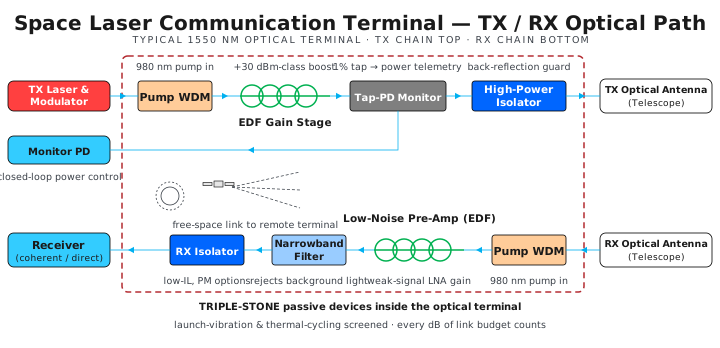
A typical 1550 nm optical terminal: the TX path includes a pump WDM, an EDF gain stage, a Tap-PD monitor and a high-power isolator; the RX path includes an EDF pre-amplifier, narrowband filtering and an RX isolator. Triple-Stone supplies the passive section in the dashed frame.
On the transmit side, 980 nm pump light enters the EDF chain through a WDM; a Tap-PD device monitors output power, and the high-power isolator reduces the effect of back-reflection before the TX antenna. On receive, the weak signal passes through an EDF pre-amplifier and a narrowband filter, and then through the RX isolator to the receiver. The laser, modulator, receiver and optical antennas are integrated by the terminal builder.
Transmit amplification and back-reflection protection. A pump/signal WDM launches pump light into the EDF chain, in-line isolators protect the seed and amplifier stages, and a Tap-PD device provides a power reading for the control loop. Power rating and package are selected for each position.
Polarization-sensitive coherent terminals can use PM devices. Where space is limited, an integrated package combining isolation and WDM functions can also be evaluated.
Low-loss receive routing and filtering. Insertion loss on receive directly consumes link margin. Low-loss circulators route weak signals, narrowband filters reduce solar background and terminal scatter, and PM versions help preserve polarization in coherent receivers.
Environmental adaptation and validation. Our Telcordia GR-1221 / GR-1073 programs provide baseline device reliability evidence; they are not a space qualification. For a specific mission, low-outgassing materials, packages, thermal cycling and radiation requirements can be discussed, with tests and acceptance criteria defined against the customer’s environmental envelope.
Consistency from prototype to production. Early prototypes may need rapid configuration changes, while production requires fixed materials, processes and test conditions. Triple-Stone supports project-specific device specifications and inspection requirements to keep insertion loss, isolation and polarization performance consistent across batches.

1550 nm in-line isolators with multiple power and PM options for back-reflection suppression in seed, amplifier and transmit paths.
View details →IWDM and pump/signal WDM for pump combining and integration in EDF amplifier chains, with different fiber and package options.
View details →Tap-PD and ITPD devices that provide in-line monitoring for amplifier control loops and terminal diagnostics, with compact package options.
View details →Relevant products are qualified under Telcordia GR-1221 / GR-1073 reliability programs.
Materials, packages and validation options can be evaluated for engineering models and small-batch programs. Samples ship worldwide.
sales@triple-stone.com
+86 137 0968 6019
OCS-based optical switching for reconfigurable, high-radix AI cluster networks.
Explore →Miniaturized passives for coherent modules, DCI platforms and long-haul systems.
Explore →Fiber-optic devices for distributed sensing and measurement.
Explore →High-power and PM components for industrial laser systems.
Explore →PM and high-peak-power devices for wind and automotive LiDAR.
Explore →Precision optical components for quantum systems.
Explore →Miniaturized custom optics for medical applications.
Explore →Active optical devices — TOSA, ROSA, BOSA — for PON and 5G fronthaul.
Explore →