Components for narrow-linewidth laser systems used in neutral-atom cooling and quantum precision measurement — PM isolators, pump WDMs, in-line power monitors and custom filters that limit back-reflection and stabilize the amplification chain.
Discuss your laser system View precision componentsQuantum experiments use light to cool, manipulate and measure atoms. The laser must remain on resonance with the atomic transition for extended periods, while optical feedback, spectral noise and power drift must be kept from degrading the measurement.
Rubidium experiments commonly use the Rb D2 (780 nm) and D1 (795 nm) transitions; metastable-helium experiments use 1083 nm. Linewidth, frequency drift and phase noise affect cooling, manipulation and measurement, so the seed laser and amplification chain should add as little noise and frequency instability as possible.
Back-reflection can cause frequency jitter or mode hops in a narrow-linewidth source, so isolators reduce its effect. ASE and out-of-band light from the amplifier add background noise and may require spectral filtering.
Wavelength, fiber type, power level and package vary widely between experiments, with PM fiber and small batches common. Devices need to fit the actual optical layout rather than simply reuse a telecom configuration.
Triple-Stone supplies the passive devices in a narrow-linewidth laser chain: PM isolators for back-reflection suppression, pump WDMs for pump/signal management, filters for out-of-band noise, and Tap-PD devices for in-line power monitoring. A Tap coupler can also supply sampled light to an external frequency-reference or beat-note detection branch.
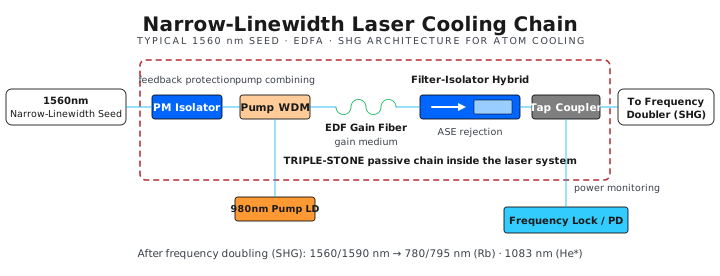
A typical 1560 nm seed-amplification and frequency-doubling chain: the seed passes through a PM isolator into the EDF stage, with filtering and Tap-based monitoring before the doubler. Triple-Stone supplies the passive section in the dashed frame.
The 980 nm pump is combined into the signal path by a WDM, and the EDF amplifies the 1560 nm seed. A filter-isolator section then suppresses ASE and back-reflection, while a Tap coupler samples light for power monitoring and can also feed an external frequency-reference or beat-note detection branch. Frequency-doubling 1560 nm light produces 780 nm, and doubling 1590 nm produces 795 nm for rubidium experiments; 1083 nm is used for metastable helium. This is one example, and devices are selected to match the actual layout.
PM isolation and spectral filtering. PM isolators sit between the seed and amplifier stages to reduce the effect of downstream reflections on a narrow-linewidth source. Single- and dual-stage options balance isolation, insertion loss and package size, while the fiber is matched to the system’s polarization requirements.
ASE and out-of-band light are handled according to the atomic transition and receiver requirements. Filter WDMs combine pump and signal, and filtering with isolation can be integrated where appropriate to reduce splices and potential reflection points.
In-line power monitoring. Tap couplers sample a small fraction of the optical power in the main path for in-line power monitoring and diagnostics, or to feed an external frequency-reference or beat-note detection branch. The split ratio is chosen for the main-path budget and monitoring needs. The Tap-PD hybrid integrates a tap coupler and a photodetector for compact laser modules.
Non-standard wavelengths and small batches. Device selection starts with the atomic transition and optical layout. Triple-Stone can evaluate 1560/1590 nm seed-amplification chains and other experimental wavelengths, with custom PM fiber, package, power and split-ratio options for research and pilot builds.

Single- and dual-stage isolators with different power and fiber options for back-reflection suppression in narrow-linewidth chains; PM circulators for optical routing.
View details →Tap couplers and Tap-PD hybrids support in-line power monitoring and diagnostics, and can supply sampled light to external frequency-reference or beat-note detection branches. Split-ratio and package options are available.
View details →Pump/signal combining and spectral filtering for EDF amplifier chains; integrated filtering and isolation can be evaluated to match the optical layout.
View details →Relevant products are qualified under Telcordia GR-1221 / GR-1073 reliability programs.
Custom wavelengths, PM fiber, split ratios and packages available for research and small-batch builds. Samples ship worldwide.
sales@triple-stone.com
+86 137 0968 6019
OCS-based optical switching for reconfigurable, high-radix AI cluster networks.
Explore →Miniaturized components for coherent modules and line systems.
Explore →Fiber-optic devices for distributed sensing and measurement.
Explore →High-power and PM components for industrial laser systems.
Explore →PM and high-peak-power devices for wind and automotive LiDAR.
Explore →Reliable photonics for space and satellite links.
Explore →Miniaturized custom optics for medical applications.
Explore →Active optical devices — TOSA, ROSA, BOSA — for PON and 5G fronthaul.
Explore →