Components for coherent wind LiDAR and 1550 nm automotive systems — PM circulators, PM MEMS switches, IWDM and WITP hybrids for coaxial transceivers, multi-channel scanning and compact fiber-laser engines.
Discuss your LiDAR design View LiDAR devicesWind and automotive LiDAR use different measurement methods, but both must handle weak returns and peak power while meeting long-term reliability requirements. Component selection depends on the architecture, not a single power or isolation figure.
A coaxial system transmits and receives through one aperture. The circulator routes the outgoing beam to the scanner and the return to the receiver. Front-end loss, isolation and reflections affect the useful signal and receiver dynamic range; coherent systems also need stable polarization.
Pulsed ToF and amplified coherent systems require attention to peak power, pulse width and fiber type. The 1550 nm band generally permits higher eye-safety limits, but the complete system must still meet the requirements of its target safety class. Fibers, splices and devices must be validated for the actual pulse conditions.
Multi-line wind sensing and multi-beam automotive systems trade channel count against switching repeatability and package size. Outdoor temperature swings, vibration and aging then have to be managed while optical performance remains consistent from batch to batch.
Triple-Stone supplies components for the laser source, transceiver and scanning path: PM circulators for coaxial routing, PM MEMS switches for channel selection, IWDM and WITP for laser-engine integration, and Tap/PD for power monitoring.
Coaxial transceivers: separating launch and return. In a coaxial pulsed or coherent LiDAR, a PM circulator routes the outgoing beam to the scanner and the returning echo to the receiver, helping limit crosstalk in the shared aperture. PM versions are used where polarization affects coherent detection.
Our 1550 nm PM 25/300 large-mode-area circulator supports 10 kW nanosecond pulses for high-peak-power fiber-laser transceivers. Standard PM circulators offer ≥40 dB isolation and ≥22 dB extinction ratio for polarization-sensitive links.
Multi-channel scanning: one transceiver, multiple directions. Wind LiDAR often switches between several lines of sight, while multi-beam automotive systems also need additional channels. A 1×N PM MEMS switch lets one source and receiver connect to each path in turn, with 4/8/16 channels, 10⁹-cycle durability and ±0.05 dB repeatability.
Laser integration and in-line monitoring. IWDM combines an isolator with a 940/1550 or 1590 nm WDM, while WITP adds a tap or band-pass filter to reduce splices and shrink the laser engine. WITP is available in PM and non-PM versions and supports 5 kW nanosecond pulses.
Tap couplers and PDs monitor source and link power. Depending on space and monitoring requirements, the design can use discrete components or an integrated hybrid.
Outdoor operation and volume production. Wind equipment operates outdoors for years, while automotive devices face temperature swings, vibration and aging. Relevant products are validated against the reliability requirements of Telcordia GR-1221 / GR-1073, and wide-temperature, fiber and package options are available for volume programs.
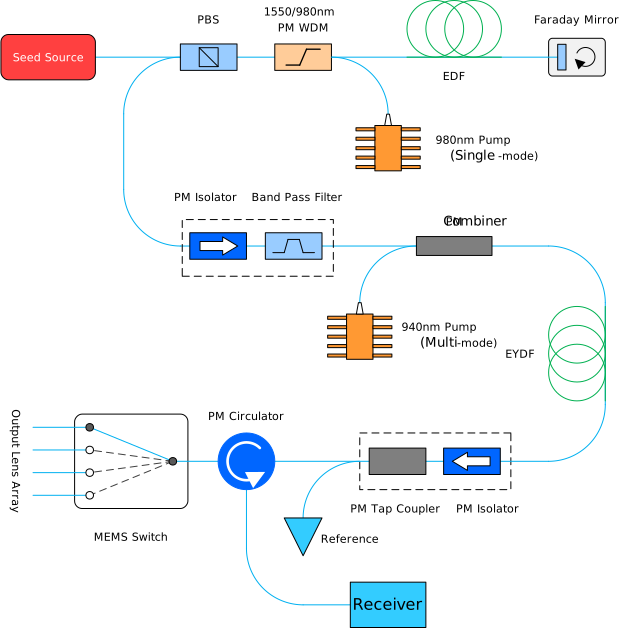
A typical 1550 nm fiber-laser LiDAR transceiver: the seed signal passes through PM isolators and is amplified in the EDF/EYDF stages, with Tap power monitoring before a PM circulator routes it into the scan path. Returning light goes to the receiver, while a MEMS switch selects scan or reference paths.
The front-end PM WDM launches 980 nm pump light into the EDF, and a Faraday mirror lets the signal pass through the gain fiber twice. A PM combiner then adds 940 nm multimode pump light for further amplification through the EYDF. PM taps and isolators provide power monitoring and back-reflection protection, and the band-pass filter suppresses out-of-band noise. Components are selected by position; not every system needs this complete chain.

The 1550 nm PM 25/300 large-mode-area circulator supports 10 kW nanosecond pulses; standard PM versions offer ≥40 dB isolation and ≥22 dB extinction ratio for coaxial pulsed and coherent transceivers.
View details →1×N PM MEMS switches with 4/8/16 channels let one source-receiver pair serve multiple lines of sight or beam paths in turn.
View details →Isolation, WDM, tap or band-pass filtering in one package, with PM and non-PM options for compact automotive and sensing fiber-laser engines.
View details →Relevant products are validated against the reliability requirements of Telcordia GR-1221 / GR-1073.
PM / LMA fiber, power-handling and package options for wind and automotive programs. Samples ship worldwide.
sales@triple-stone.com
+86 137 0968 6019
OCS-based optical switching for reconfigurable, high-radix AI cluster networks.
Explore →Miniaturized components for coherent modules and line systems.
Explore →Fiber-optic devices for distributed sensing and measurement.
Explore →High-power and PM components for industrial laser systems.
Explore →Precision optical components for quantum systems.
Explore →Reliable photonics for space and satellite links.
Explore →Miniaturized custom optics for medical applications.
Explore →Active optical devices — TOSA, ROSA, BOSA — for PON and 5G fronthaul.
Explore →