How We Fit In
Triple-Stone supplies the passive optical layer inside coherent modules and along the line — wherever loss, polarization and size matter.
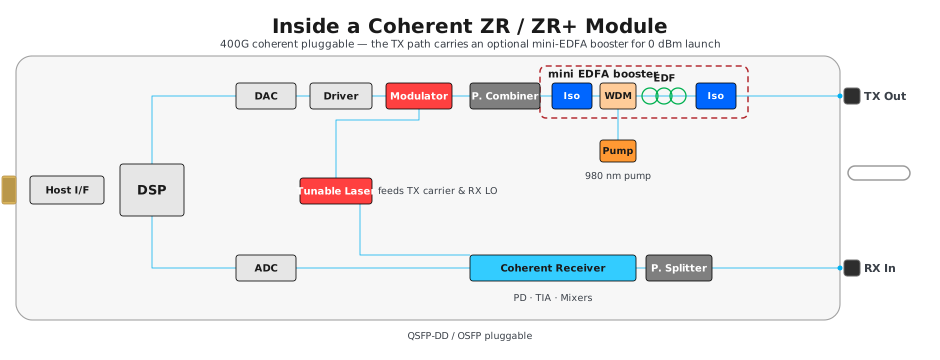
Inside a coherent ZR/ZR+ module, the mini EDFA (highlighted) sits in the TX output chain and amplifies the modulated signal; the RX path does not pass through this amplifier.
Read the module diagram from left to right. On the TX side, the host electrical interface feeds a DSP, then a DAC, a driver and an IQ modulator; after the two polarizations are combined, a mini EDFA boosts the signal before it reaches the TX fiber. On the RX side, light passes through a polarization beam splitter and enters the coherent receiver, where it is mixed with the local oscillator from the same tunable laser, and the recovered signal returns through the ADC to the DSP. The red frame marks the passive part of the booster, where we can supply the isolators, IWDMs and photodetectors (PDs).
In some high-power ZR/ZR+ coherent modules, the need for a higher link budget makes an integrated EDFA an important option. At the same time, equipment density in data centers and equipment rooms keeps climbing, so external EDFAs must carry more channels within limited rack space, moving from single-path amplification to multiple parallel paths. In both coherent modules and external EDFAs, miniaturization, higher integration and array packaging are the key design priorities for passive devices.
Inside coherent modules, we solve the space problem with hybrid integration and folded optical paths. Our IWDM combines isolation and pump coupling in one package, reducing discrete parts and splice points; folded optical paths route light back within a compact volume, further reducing the footprint. Together with PM devices offering low insertion loss and a high extinction ratio, these integration approaches preserve optical performance within constrained module outlines.

A typical passive chain for an external multi-stage EDFA — tap/PD monitors, isolators, pump WDMs, EDF, GFF, TOF and VOA (dashed frames mark same-package hybrids). Triple-Stone can supply the passive devices in this chain.
An external EDFA contains a range of passive devices with distinct roles: the tap + PD assembly monitors power, isolators suppress back-reflection, the WDM couples pump light, the GFF flattens gain, the TOF suppresses out-of-band ASE, and the VOA adjusts output power. Dashed frames mark multiple functions integrated into one hybrid device, allowing one package to replace several discrete components.
In external and multi-stage EDFAs, we combine devices to match the link. IGFF and WIGW handle isolation and gain flattening, Tap PDs monitor power and MEMS VOAs adjust channel power; for parallel amplification, array products such as the 4-in-1 isolator and 2-in-1 IWDM cut device count and board space further. That eases line-card integration and reduces assembly and connection work.
Take ITPD as an example: the early package was Φ5.5×25 mm, and the current ultra-small version is Φ1.4×16 mm — about 75% smaller in diameter, about 36% shorter, and roughly 1/24 of the original volume based on the package dimensions. Miniaturization is not only about a smaller outline: low insertion loss, high isolation and monitoring accuracy must all be maintained, which is where our device design and packaging expertise comes into play.
We tailor device combinations, package matching and custom development to each customer's module outline, channel count and performance targets. With more than ten years of volume production experience in miniaturized hybrid devices, we respond quickly to requests for component selection and customization support and help customers shorten evaluation and prototyping cycles.