Home / Applications / Medical Photonics
Applications

Medical Photonics

Miniature passive devices for OCT and medical optical systems — couplers, circulators, VOAs and delay lines — with project-specific evaluation of FBG options and interferometric sub-module integration based on your block diagram.

Discuss your optical design View OCT components

The Challenge

OCT derives depth information from interference between sample and reference light. Couplers, circulators, delay lines and fibers all sit in the measurement path, so their loss, split ratio and polarization directly affect image quality and stability.

Keeping the Interferometer Balanced

Split ratio, insertion loss and reflections in the sample and reference arms affect the usable signal level and background noise. Some errors can be corrected through calibration, but component imbalance and reflections cannot simply be removed in software. Polarization-sensitive OCT also requires controlled polarization through the optical path.

k-clock Accuracy and Sweep Triggering

Samples taken at uniform time intervals may not be evenly spaced in the wavenumber (k) domain; a k-clock interferometer therefore provides a reference for uniform-k sampling or resampling, while a fixed-wavelength FBG can provide a trigger for each A-scan. The performance and stability of the delay lines, couplers and FBG affect sampling and image alignment.

Miniaturization and Volume Consistency

Endoscopic and catheter-based OCT is sensitive to device size and splice count, while medical platforms require a consistent component supply over many years. Devices must be compact while maintaining consistent split ratio, insertion loss and isolation across batches.

How We Fit In

Triple-Stone supplies passive devices for the sample arm, reference arm, k-clock and sweep-trigger path. We can provide individual devices by wavelength, split ratio and package, or evaluate interferometric sub-module integration against your block diagram.

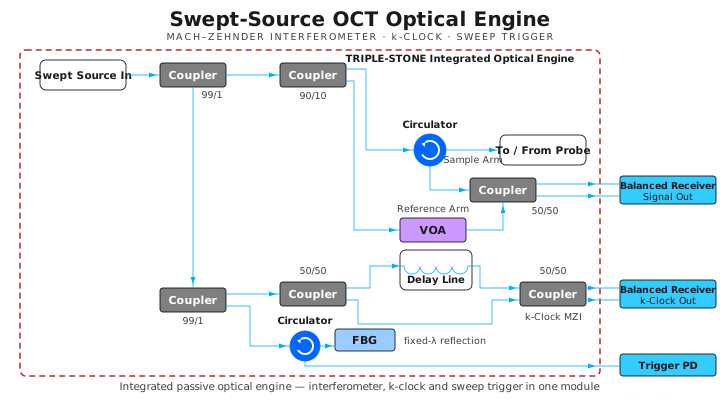
Typical swept-source OCT optical engine architecture: sample and reference arms, k-clock interferometer with precision delay line, and FBG sweep trigger — passive devices and integration evaluation by Triple-Stone

A typical swept-source OCT passive optical engine: the sample and reference arms generate the measurement signal; the k-clock provides the sampling reference, and an FBG can provide the sweep trigger. Triple-Stone supplies couplers, circulators, VOAs and delay lines, and can evaluate FBG options for the project and integration of interferometric sub-modules.

Couplers split the swept light so that one portion reaches the probe through a circulator and returns through it, while the other enters the reference arm, where an optional VOA can adjust the power balance between the arms. The recombined signal goes to a balanced receiver. Additional light feeds the k-clock interferometer and FBG trigger branch, providing the sampling reference and A-scan trigger.

Interferometric devices. Wideband 2×2 couplers split the sample and reference light, and Tap couplers provide low-ratio optical sampling for monitoring, with split ratio and excess loss matched to the optical budget. Circulators separate launch and return on the same fiber; low insertion loss and high isolation help preserve the sample-return signal and limit background noise.

Polarization-sensitive OCT can use PM couplers, PBS devices and PM circulators to reduce polarization-related variation. Mini and ultra-mini packages suit compact OCT engines and probe modules.

k-clock and sweep trigger. A k-clock interferometer uses a fixed optical path difference to generate an interference reference for uniform-k sampling or resampling. A fixed-wavelength FBG reflection can provide the sweep trigger. Triple-Stone supplies the delay lines, couplers and circulators, and can evaluate FBG options for the project along with suitable fiber and package choices.

Module integration and volume delivery. The passive optical engine shown here for a swept-source OCT system may be configured with several couplers, circulators, VOAs, delay lines and FBGs according to system architecture; k-clock and sweep-trigger branches are selected according to source and acquisition design. Triple-Stone can evaluate splicing and integration to reduce the number of external connections and the overall footprint, with inspection criteria defined for split ratio, insertion loss, return loss and polarization. Production then uses the specified materials and processes under fixed test conditions to maintain consistency between batches.

Products for This Application

Mini & Ultra-mini Circulators

For launch/return separation in OCT probes and interferometers, with wavelength, package and PM options for compact optical modules.

View details →

Couplers & Tap Monitoring

Custom-ratio couplers and Tap-PD devices for sample and reference arms, k-clock and in-line power monitoring.

View details →

VOA, Delay Lines & Integration

VOAs, precision delay lines and related passives for reference balancing, k-clock and sweep triggering; integrated options are evaluated against the block diagram.

View details →
1,500+Employees
61,000 m²Floor Space
4Manufacturing Facilities
500+Customers
3R&D Centers
62Patents

Relevant products are qualified under Telcordia GR-1221 / GR-1073 reliability programs.

Designing an OCT engine or medical optical system?
Tell us your wavelength, split ratio, fiber type and package requirements.

We offer customization of individual devices and evaluation of passive sub-module integration for research and small-batch programs. Samples ship worldwide.

sales@triple-stone.com
+86 137 0968 6019

Verification code

Other Applications